

I was recently chatting with a CEO of a home improvement company who, upon implementing an AI call recording software with his field reps, made a shocking discovery:
His reps were rooted 100% in manipulative, dishonest selling.
And it was BAD.
While they managed to close deals, the way they were doing it was deeply disturbing to him, especially because he realized there was very little genuine connection occurring with the homeowner, causing below-average customer reviews as well as an usually high cancellation rate.
All this came from a legacy sales system they were taught that was rooted in creating false urgency, fear, and even customer overwhelm.
Specifically, here are some of the techniques that, in hindsight, made the CEO feel sick to his stomach to observe from his team:
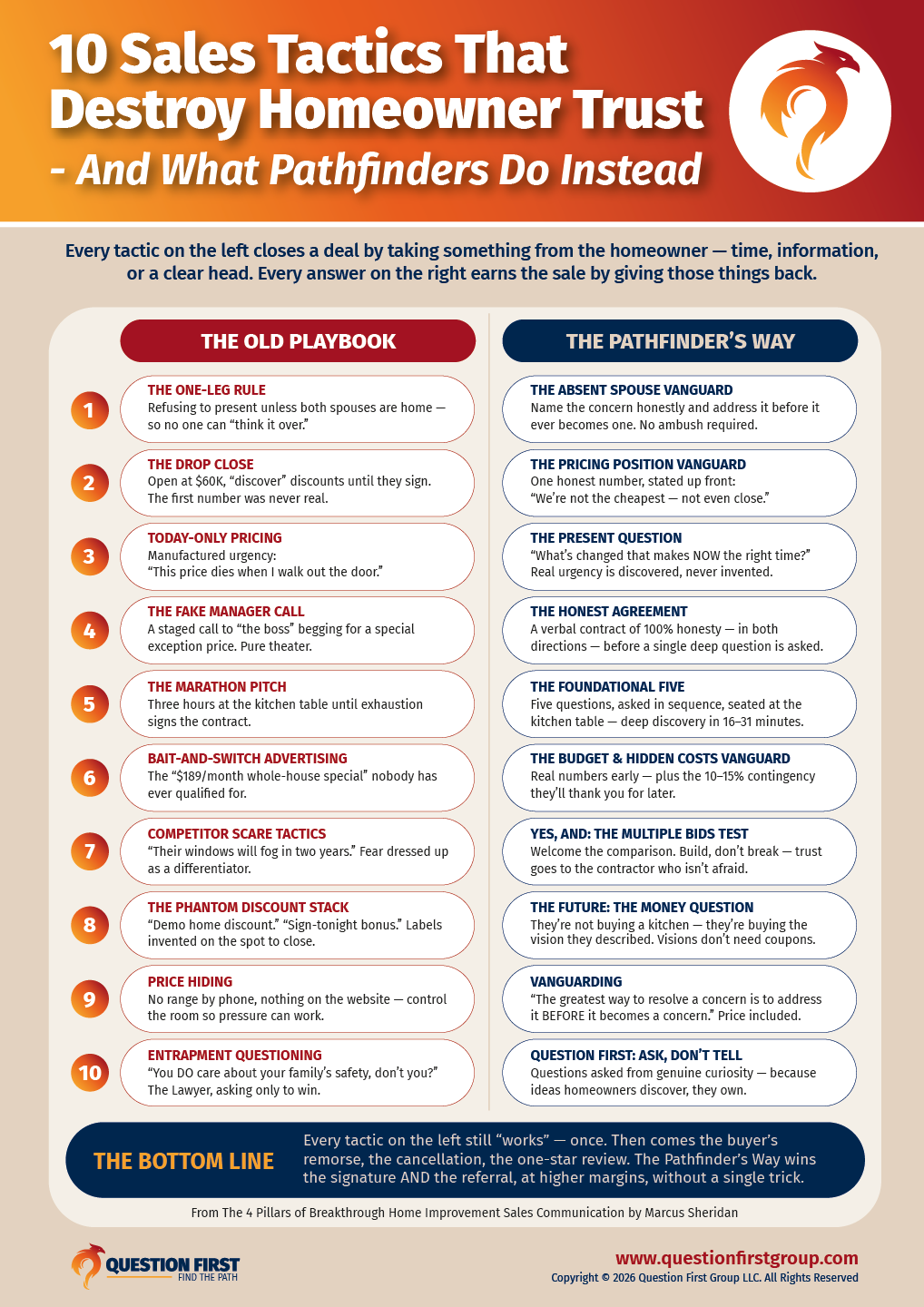
- The “one-leg” rule – Incredibly common in home-improvement, this is when a rep refuses to present or quote unless both spouses/decision-makers are present. Always framed as convenience, it’s really about blocking the “let me talk to my spouse” escape route and enabling same-night pressure.
- The drop close – Opening with a wildly inflated price, then “discovering” discounts as the homeowner hesitates. A $60K quote becomes $32K in an hour. Homeowners eventually realize the first number was fiction, often leaving them feeling manipulated and taken advantage of.
- “Today-only” pricing – Maybe the worst of the worst. This is THE signature deadline tactic in home improvement and this CEO’s team used it in every home: “This price expires when I walk out the door.” Manufactured urgency that punishes homeowners for wanting to think, compare, or sleep on a five-figure decision. (again, kills trust short and long term)
- The fake manager call – I can only shake my head at this one, but it’s still alive and well. This is when the salesperson theatrically phones “the boss” to beg for a special exception price. Pure performance designed to create obligation and the illusion of a hard-won deal.
- Trash-the-competitor scare tactics – “Their windows will fog in two years,” “that company is about to go under.” Fear-based disparagement instead of honest differentiation. In this company’s case, as well as most others, it’s fabricated, and always corrosive to trust.
- Hiding the price / refusing to quote remotely – Don’t even get me started on this one. Like so many others in home improvement, his team wouldn’t even give even a range by phone or on the website, insisting price “depends.” What this practice is really about is controlling the environment so pressure tactics can work.
- Leading, entrapment-style questioning – “You do care about your family’s safety, don’t you?” A scripted chain of yes-momentum questions designed to make “no” feel morally wrong. In our Pathfinder system of communication, we call this communication style “The Lawyer,” ultimately leading the homeowner to feel manipulated and taken advantage of.
Every single one of these manipulative sales techniques has a better way. That’s why we created this free one-page guide, showing what to stop doing and what to do instead. Download it and share it with your team.
I was recently chatting with a CEO of a home improvement company who, upon implementing an AI call recording software with his field reps, made a shocking discovery:
His reps were rooted 100% in manipulative, dishonest selling.
And it was BAD.
While they managed to close deals, the way they were doing it was deeply disturbing to him, especially because he realized there was very little genuine connection occurring with the homeowner, causing below-average customer reviews as well as an usually high cancellation rate.
All this came from a legacy sales system they were taught that was rooted in creating false urgency, fear, and even customer overwhelm.
Specifically, here are some of the techniques that, in hindsight, made the CEO feel sick to his stomach to observe from his team:
- The “one-leg” rule – Incredibly common in home-improvement, this is when a rep refuses to present or quote unless both spouses/decision-makers are present. Always framed as convenience, it’s really about blocking the “let me talk to my spouse” escape route and enabling same-night pressure.
- The drop close – Opening with a wildly inflated price, then “discovering” discounts as the homeowner hesitates. A $60K quote becomes $32K in an hour. Homeowners eventually realize the first number was fiction, often leaving them feeling manipulated and taken advantage of.
- “Today-only” pricing – Maybe the worst of the worst. This is THE signature deadline tactic in home improvement and this CEO’s team used it in every home: “This price expires when I walk out the door.” Manufactured urgency that punishes homeowners for wanting to think, compare, or sleep on a five-figure decision. (again, kills trust short and long term)
- The fake manager call – I can only shake my head at this one, but it’s still alive and well. This is when the salesperson theatrically phones “the boss” to beg for a special exception price. Pure performance designed to create obligation and the illusion of a hard-won deal.
- Trash-the-competitor scare tactics – “Their windows will fog in two years,” “that company is about to go under.” Fear-based disparagement instead of honest differentiation. In this company’s case, as well as most others, it’s fabricated, and always corrosive to trust.
- Hiding the price / refusing to quote remotely – Don’t even get me started on this one. Like so many others in home improvement, his team wouldn’t even give even a range by phone or on the website, insisting price “depends.” What this practice is really about is controlling the environment so pressure tactics can work.
- Leading, entrapment-style questioning – “You do care about your family’s safety, don’t you?” A scripted chain of yes-momentum questions designed to make “no” feel morally wrong. In our Pathfinder system of communication, we call this communication style “The Lawyer,” ultimately leading the homeowner to feel manipulated and taken advantage of.
Every single one of these manipulative sales techniques has a better way. That’s why we created this free one-page guide, showing what to stop doing and what to do instead. Download it and share it with your team.

Again, I want to stress that the CEO wasn’t the bad guy here at all. He’d simply had his sales team follow a legacy system that thousands of other companies also follow to this day.
The irony in all of this is that not only did the system lead to a massive amount of buyer’s remorse, regret, and cancellations—but it also led to the CEO now feeling a massive amount of remorse and regret himself.
Which brings us to The Pathfinder System, something the CEO had heard me talk about from stage and immediately when hearing it felt the light bulbs come on—an answer to what he’d been feeling for a while but didn’t know where to turn.
Pathfinder is the literal antithesis of old-school, one-call-close selling techniques.
No manipulation.
No BS.
Just real connection, deep trust, and honest conversations.
And, even better, when done correctly, has a much higher closing rate than the “old” way of selling, with dramatically less cancellations.
Friends, my team and I at Question First Group are on a mission to help leaders and sales teams communicate with more trust, transparency, and connection.
But it starts with this realization:
You do NOT have to manipulate to be effective at selling.
Nor do you have to manipulate to be effective at leading.
Instead, you must master four skills, or, as we call it, The 4 Pillars of Pathfinder Communication:
- Yes, And: Understand how to have the *perfect* energy (and response) in every interaction. Unflinching. Earned confidence. Always building.
- Vanguarding: Discover how to get in front of any friction BEFORE it even manifests.
- Question First: Learn the art of asking the perfect question—and also how to literally *think* in the form of a question.
- Law of 3: Develop the power of always getting to the core of the actual issue, problem, need, etc. This is where light bulb moments are created and connection with the prospect (or team member) is galvanized.
If any of this resonates with you, as it did with our CEO friend, then check out any of our books here.

And, again, you CAN sell with integrity and surpass your sales goals.
The two are NOT mutually exclusive.
To More Trust and Connection,
– Marcus
From the Known & Trusted Newsletter
Join the discussion on LinkedIn – or sign up to receive the latest articles by email.